


By Maria Lisak
The ground beneath English language teaching is shifting. In East Asia, demographic collapse is shrinking student populations. AI threatens to automate skill-based learning. Public education faces budget cuts, while online platforms commodify teaching with little oversight. For many, a once-stable career in EFL feels increasingly precarious, if not obsolete.
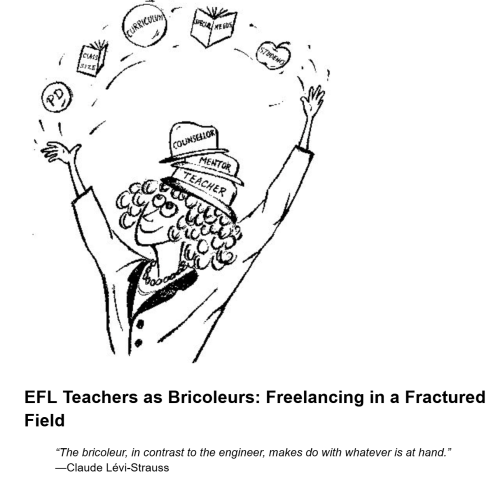
Amid this flux, it's often individual teachers, especially freelancers, who hold learning environments together. More and more EFL educators are identifying not as employees, but as bricoleurs: creative improvisers stitching together gigs, projects, and digital platforms to survive and sometimes thrive in a fractured field.
But let’s be honest: not everyone gets to wear the “freelancer” label with pride.
Who Gets to Freelance? Who Has To?
To some, freelancing evokes freedom: digital nomads teaching from Bali, teacherpreneurs launching Instagram coaching programs. But for many others, especially racialized, “non-native,” or Global South educators, freelancing is not a lifestyle choice; it’s the only option left.
The same hustle.
Radically different framing.
Radically different pay.
Radically different gatekeeping.
Filipino teachers are often hired for a fraction of what white Western teachers earn. Nigerian teachers are overlooked due to accents. In these cases, freelancing isn’t seen as entrepreneurial; it’s framed as cheap labor. The industry celebrates "creativity" when it’s white and Western; when it’s brown and Global South, it's compliance or invisibility.
The Myth of Professionalization
Institutions talk a lot about “professionalizing” EFL, but what does that really mean?
Too often, professionalization serves as a glossy veneer for instability:
- Overemphasis on credentials (CELTA, MA TESOL) without job security
- Platforms branding teachers while denying labor protections
- Paywalls for credibility, priced in Western currencies
Worse, “professionalism” is often code for white, Western norms: standard accents, Eurocentric dress, and sanitized global English. Teachers from the Global South are told to over-certify, neutralize their identities, and erase their accents just to compete. In much of the EFL world, professionalism still means proximity to whiteness.
In South Korea, highly qualified Korean English teachers often find themselves passed over for leadership roles or higher-paying jobs in favor of those with Western credentials. Even when working in private academies or freelance contexts, Korean teachers are sometimes expected to “prove” their fluency through native-like pronunciation or foreign university degrees. Their local knowledge, multilingual agility, and cultural competence are too often undervalued, even as they bear the brunt of parental expectations and curricular implementation.
Bricoleurs, Not Just Gig Workers
Rather than embrace the hustle-culture “freelancer” label, we can reclaim the idea of the bricoleur, a figure who adapts creatively, assembles from what's available, and survives with ingenuity.
Bricoleurs:
- Design hybrid careers across platforms, geographies, and time zones
- Translate pedagogy, culture, and technology
- Innovate where institutions lag
- Act as stopgaps and frontline responders to systemic failure
Freelance EFL teachers aren’t outliers. They’re the ones holding the field together while it falls apart.
From Survival to Reimagination
Many freelancers are moving from individual survival to collective reimagination:
- Building mentorship networks and open-access materials
- Organizing against exploitative policies on platforms
- Centering multilingualism and rejecting the native/non-native binary
A new wave of educators from Latin America, Southeast Asia, Africa, and Eastern Europe is not just freelancing; they’re reshaping the pedagogical future. They’re asserting that English doesn’t belong to one region or race. It belongs to everyone.
What Comes Next?
If institutions can’t evolve fast enough, then maybe freelancers aren’t just reacting; they’re leading. But they can’t do it alone. We need:
- Policy frameworks that recognize independent teachers
- Hiring practices that reject native-speakerism
- Funding and platforms that support multilingual, local expertise
- A new definition of “professional” rooted in equity, not accent
Freelancers aren't just surviving the collapse. They're quietly redesigning the field from the margins. But we can’t leave that labor invisible or unsupported.
If you’re a school leader, hiring manager, or curriculum coordinator:
- Reflect on how native-speakerism shapes your job ads and hiring filters
- Invest in multilingual teachers’ leadership and ongoing development
- Resist one-size-fits-all definitions of “professional” English
If you’re a teacher, freelance or not:
- Mentor others navigating similar challenges
- Push back against accent bias when you hear it
- Collaborate on open-access materials that celebrate diverse Englishes
If you’re Korean and feeling pushed to the periphery of the field you helped build:
- Know you're not alone. Your expertise matters.
- Share your story. It’s part of a larger movement toward equity.
- Reclaim English teaching not as mimicry, but as transnational practice.
The future of EFL doesn’t need to look like its past. It can be rooted in mutual respect, shared knowledge, and multilingual imagination. The future of EFL depends on listening to those already building it from the margins.
The Author
With over 30 years of EFL experience, Maria Lisak, EdD, is a full-time professor in the Department of Administration Welfare at Chosun University, where she teaches social entrepreneurship in English using experiential learning and sociocultural approaches. Her work integrates constructivist and emancipatory frameworks, with research focusing on funds of knowledge, Gwangju as Method, and social justice education. She also designs educational technologies and materials for diverse ESP contexts, linking classroom practice with community needs. Her current interests include literacy, culture, and language education, and participatory frameworks for teacher wellbeing. She is the current president of the Gwangju-Jeonnam Chapter of KOTESOL, and a lifetime member of KOTESOL and AsiaTEFL. Her interdisciplinary work invites reflection on multimodal pedagogies, material making, and context-driven innovation in borderland spaces.


