

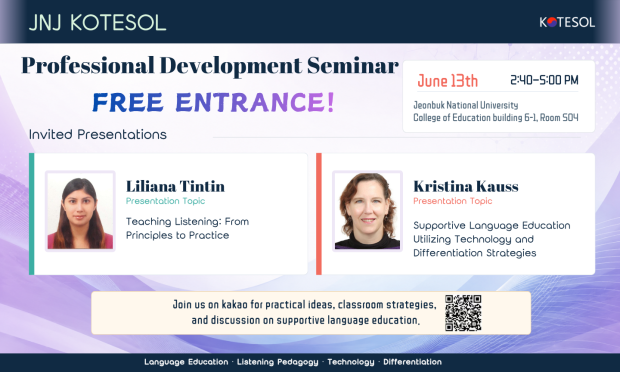
Join Jeonju North Jeolla KOTESOL this June for an afternoon of practical ideas and thoughtful discussion for today’s EFL classroom.
The first speaker will be our own Jeonbuk chapter lifetime member, Liliana Tintin.
Title: Teaching Listening: From Principles to Practice
Abstract
This presentation aims to examine principles and practical applications of teaching listening as an active, interpretive process. Drawing on Brown & Lee (2015) and the CELTA receptive skills framework, the session analyzes two sample lessons: The Whale's Tale (academic/narrative) and What Am I Taking/Packing? (pre-intermediate, listening for specific information with quantifiers).
The presentation demonstrates how top-down and bottom-up strategies can be integrated effectively, how CELTA staging supports lesson coherence, and how tasks can be adapted for different proficiency levels (A1 to B2+). Participants will engage in peer analysis using guiding questions and leave with adaptable strategies for their own classrooms.
Bio
Liliana M. Tintin is originally from Ecuador, South America. She has been living on and off in Korea since 1996. She got her B.A. in International Studies in Jeonju at Jeonbuk National University. She is currently getting her M.A in English Education at the same university. Liliana has been teaching for more than 15 years in various academies and in her private practice, IT’S ENGLISH. She has been involved in various research papers which have been published in academic journals. She completed a CELTA certification a few years ago in Ecuador and is very happy to have survived the CELTA training!
Our next speaker will be Kristina Kauss, coming in from out of province.
Title: "Supportive Language Education Utilizing Technology and Differentiation Strategies"
- Workarounds for the undiagnosed neurodivergent in EFL classes.
Abstract
This workshop explores inclusive EFL instruction through low-cost technologies and differentiation strategies. Drawing on personal experience from South Korea, it addresses the challenges faced by teachers in systems with cultural and institutional constraints. Practical, domain-based activities will be presented grounded in Universal Design for Learning, Bloom's taxonomy, and assistive tools such as speech-to-text and text-to-speech. Reframing support tools as inclusive and universal rather than exceptional, advocating accessible, culturally responsive classrooms where everyone can thrive. Classrooms are increasingly diverse in learning profiles. Many EFL teachers encounter students who show signs of learning differences like dyslexia, ADHD, and processing challenges. Yet in many educational systems, including South Korea's, official diagnoses are rare due to cultural stigma and institutional barriers. Teachers cannot suggest evaluation, and parents may resist labelling.
Neurodivergence includes dyslexia, ADHD, and language learning disabilities, which are not exclusive to English but exist across all cultures and languages, including Korea. Dyslexics struggle with decoding, spelling, and phonological awareness. ADHD may manifest as distractibility or inconsistent focus, often mistaken for laziness. As Shaywitz notes, effort cannot override neurological wiring. In Korea, undiagnosed learners fall through the cracks due to rigid expectations and a lack of support. Teachers may recognize the signs but feel powerless to intervene. For example, a student wasn't evaluated until Grade 8. Another was labelled "not intelligent” but excelled during hands-on activities. These examples call for universal, stigma-free strategies.
Bio
Kristina Kauss is an educator who has taught students from elementary to university, as well as in teacher training programs, for over 17 years in Korea. She focuses on student-centred inclusive pedagogy and supporting multilingual and neurodiverse learners through differentiated instruction. She is the KOTESOL Gyeonggi Chapter President and a Master of Education candidate (expected November 2026).
https://koreatesol.org/content/jeonju-north-jeolla-june-2026-workshop