


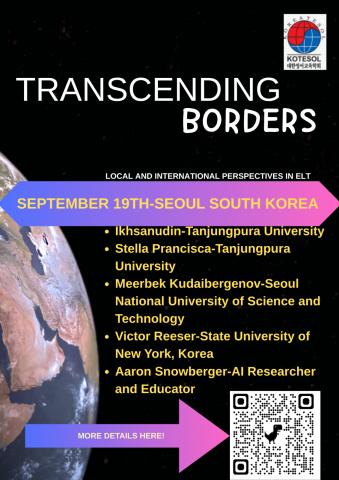
Stella Prancisca
Short Bio:
Stella Prancisca is the head of the language centre of Tanjungpura University. She currently strives multiple efforts to promote not only the English language but also other world languages. She also actively conducts research and has disseminated the results in many ELT conferences in Indonesia and overseas. Currently, her research focuses on the extensive reading program and how this program can be integrated with local materials to promote students' literacy and critical thinking skills, especially in West Kalimantan Province.
Title:
From Local Culture to Global Literacy: Designing Extensive Reading Materials through DBR
Abstract:
Extensive Reading (ER) programs have been widely regarded as a viable approach to fostering global literacy due to their efficacy in facilitating implicit language acquisition. In Indonesia, the program has gained a massive popularity marked by the establishment of the Indonesia Extensive Reading Association, a community that gather ER enthusiasts and promote ER program nationwide. Despite this promising movement, their implementation is constrained by the dominance of foreign culture in globally published graded readers. Available reading materials are overwhelmingly saturated with foreign-centric narratives, foreign character names, and alien cultural settings, which are not familiar for readers in this research context. This cultural misalignment makes the materials less relatable for local learners, potentially hindering their comprehension and undermining their motivation to read. To address this imbalance, the author designed a series of locally grounded digital graded readers (Levels 1–3) that integrate the cultural narratives of Malay, Dayak, and Chinese ethnic groups from West Kalimantan, Indonesia. Adopting a Design-Based Research (DBR) framework, the study utilized the ADDIE model to ensure a systematic and iterative material development process. The research was theoretically underpinned by Culturally Relevant Pedagogy (CRP) and ER principles, ensuring materials were both linguistically accessible and culturally validating. The study employed a longitudinal, two-macro-cycle DBR design consisting of a pre-survey, Cycle 1 reading, mid-survey, Cycle 2 reading, and a final post-survey. The results present a comprehensive analysis of student engagement and reading challenges across different language proficiency levels. This study delivers a systematically validated, scalable model for creating inclusive ELT resources that foster both language proficiency and cultural pride in diverse, non-Western higher education settings. This project serves as a starting point, with the hope that more materials will be developed in the future to cover the diverse cultures across all provinces in Indonesia.
Keywords: Extensive Reading, Graded Readers, ADDIE, Design-Based Research, Culturally Relevant Pedagogy
Title
Beyond the Conference Badge: What I’ve Learned from Attending Academic Conferences
Abstract
Academic conferences are often presented as essential spaces for sharing research, receiving feedback, and building professional networks. But what do we actually gain from attending them? Drawing on my experiences participating in conferences, workshops, colloquia, and academic events in and out of Seoul, this talk offers a practical and reflective look at the conference landscape in Korean ELT. I will discuss the types of institutions and organizations that host conferences, the themes and emerging trends I have encountered, the financial and time costs involved, and how I decide whether an event is worth attending. More importantly, I will reflect on what happens beyond the formal presentation: the conversations, questions, and networking opportunities that have influenced my research, teaching, and professional development. I will also share practical lessons about presenting research, making meaningful connections, following up after conferences, and perhaps turning conference experiences into concrete changes in academic practice.
Bio
Meerbek Kudaibergenov obtained his PhD from Hankuk University of Foreign Studies in 2021. He currently serves as an Assistant Professor at the Institute for Language Education & Research, Seoul National University of Science & Technology (SeoulTech). His research focuses on student and teacher identity, international education, and country image. He is a coordinator of the SeoulTech Language Education Colloquium and serves as a senior editor of the Journal of International Students. ORCID: https://orcid.org/0000-0001-7717-9473
Presenter: Ikhsanudin
Unversitas Tanjungpura, TEFLIN Kalimantan Barat Chapter Coordinator, Indonesia
Short Bio
Ikhsanudin is an Associate Professor of English Language Education at Universitas Tanjungpura, Pontianak, Indonesia. He serves as Editor-in-Chief of the nationally indexed Journal of English Language Teaching Innovations and Materials (Jeltim) and as Coordinator of the West Kalimantan Chapter of the Association for the Teaching of English as a Foreign Language in Indonesia (TEFLIN). His academic interests include applied linguistics, English language teaching, language pedagogy, and materials development. An invited speaker at international conferences across Asia, Europe, and North America, he has over 35 years of experience as a teacher educator, teaching language skills, linguistics, and language pedagogy.
Title:
Voice Matters: Reframing ELT Materials Evaluation through the VOLLEY TIME Framework
Abstract:
The unprecedented growth of digital and print-based English Language Teaching (ELT) materials has created new opportunities as well as new challenges for teachers in selecting pedagogically sound, contextually relevant, and ethically responsible learning resources. While existing ELT materials evaluation frameworks have made substantial contributions to the field, they tend to place greater emphasis on linguistic and pedagogical dimensions than on the voices, ideologies, and perspectives embedded within instructional discourse. This paper introduces the VOLLEY TIME Framework, a comprehensive model for ELT materials evaluation designed to address the demands of twenty-first-century language education. Although the presentation provides an overview of the framework's ten interrelated principles, particular attention is devoted to Voice in Discourse, the first principle, which foregrounds authenticity, contextual relevance, critical discourse awareness, inclusivity, and ethical communication. The paper argues that language teaching materials are never ideologically neutral; rather, they communicate particular worldviews that influence learners' linguistic, cultural, and social development. Through an extensive literature review, ten evaluation criteria for Voice in Discourse were identified and are currently undergoing expert validation involving seven ELT specialists from Indonesia and Malaysia. The presentation discusses the theoretical rationale underpinning this principle and demonstrates how integrating discourse awareness into materials evaluation can strengthen critical literacy while complementing other dimensions of the VOLLEY TIME framework, including organisation, language, learner needs, pedagogy, technology, learner autonomy, cognitive engagement, individual differences, and ecological awareness.
Keywords:
Critical discourse analysis; ELT materials evaluation; language teaching materials; voice in discourse; VOLLEY TIME framework.


